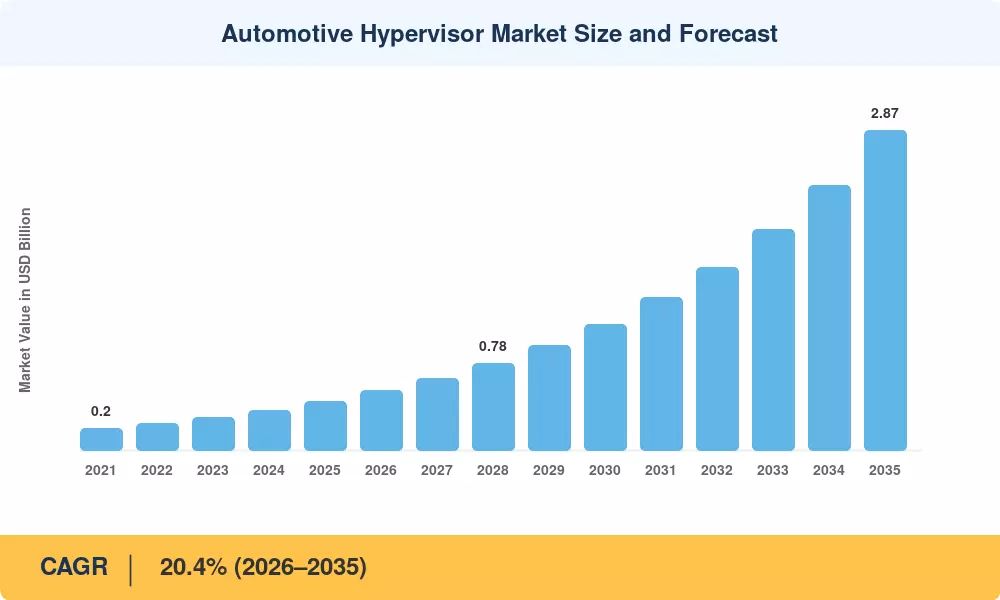
Automotive Hypervisor Market to Reach USD 2.87 Billion by 2035, Growing at 20.4% CAGR
Asia-Pacific captured 35.2% share in 2025. North America contributed USD 0.13 billion in 2025. South America grew at
Press Release Disclaimer: This is a press release distributed through the XPR Media network. It has not been independently verified by our newsroom.

Asia-Pacific captured 35.2% share in 2025.
North America contributed USD 0.13 billion in 2025.
South America grew at 21.4% CAGR from a small base.
NEW YORK, NY, UNITED STATES, August 27, 2026 /EINPresswire.com/ — According to Market Research Future, the Automotive Hypervisor Market is projected to reach USD 2.87 Billion by 2035, registering a CAGR of 20.4% during the forecast period. This exceptional growth reflects the automotive industry’s structural transition from hardware-focused vehicle architectures to software-defined vehicles built around centralized computing platforms, where hypervisors have become foundational technology for managing mixed-criticality workloads. The Automotive Hypervisor Market press release highlights the growing importance of virtualization in enabling safe and secure multi-OS environments in modern vehicles. The Automotive Software Market has seen parallel expansion as the entire automotive industry undergoes digital transformation.
Market Overview
Automotive hypervisors are virtualization software platforms that enable multiple operating systems to run concurrently on a single hardware platform, allowing better resource management and improved efficiency. They provide a critical abstraction layer that separates safety-critical applications from non-critical functions, ensuring that real-time, ASIL-D safety systems can coexist with complex infotainment and connectivity software on shared hardware resources. As vehicles become increasingly connected, autonomous, and software-driven, hypervisors are emerging as essential enablers of modern vehicle architectures.
The key growth drivers propelling this market expansion include the rapid adoption of software-defined vehicle architectures, which rely on centralized computing platforms that require hypervisors to manage workload isolation and resource allocation. The increasing complexity of advanced driver assistance systems and the progression toward autonomous mobility have heightened the need for strict separation between safety-critical and non-critical applications. The consolidation of multiple electronic control units into fewer domain and central controllers is streamlining vehicle architecture, reducing wiring complexity, and improving system efficiency.
Technological developments are reshaping the hypervisor landscape at an accelerating pace. Type 1 bare-metal hypervisors, which operate directly on vehicle hardware without an underlying operating system, dominate the market, providing deterministic real-time performance essential for ADAS and powertrain control systems. The performance advantages of bare-metal architectures become particularly pronounced in mixed-criticality scenarios where ASIL-D safety functions must coexist with non-safety applications on shared hardware resources. Green Hills Software’s INTEGRITY Multivisor and Wind River’s Helix Virtualization Platform provide hardware-assisted virtualization features enabling strict temporal and spatial partitioning required for functional safety compliance.
Market Segmentation
The automotive hypervisor market is segmented based on type, vehicle type, mode of operation, application, and demand type.
By Type: The market is categorized into Type 1 Bare-Metal Hypervisor and Type 2 Hosted Hypervisor. Bare-metal hypervisors hold approximately 77% market share, reflecting their ability to interact directly with vehicle hardware, minimizing response latency and supporting real-time system performance essential for safety-focused automotive applications. Type 2 hosted hypervisors, despite a smaller share, are experiencing rapid growth driven by their flexibility in development environments and ease of integration with existing Linux-based infotainment platforms. Bare-metal architectures are projected to grow at a CAGR of 34.3% through 2035, driven by increasing demand for safety-certified virtualization platforms.
By Vehicle Type: The market is divided into Passenger Cars, Light Commercial Vehicles, Heavy Commercial Vehicles, and Buses & Coaches. Passenger cars account for approximately 71% of deployments, driven by the segment’s high-volume production and increasing integration of advanced infotainment and ADAS features that benefit from domain consolidation. Light Commercial Vehicles represent the fastest-growing category, owing to rapid digitalization of fleet operations and adoption of connected, software-driven architectures. Rising demand for real-time telematics, driver assistance, and over-the-air updates in logistics and last-mile delivery fleets is accelerating hypervisor integration.
By Mode of Operation: The market serves Semi-Autonomous, Autonomous Vehicles, and Conventional vehicles. The autonomous vehicle segment is expanding rapidly as hypervisors enable integration of critical systems such as ADAS and vehicle-to-everything communication, essential for safe autonomous operation. Semi-autonomous vehicles require hypervisors to manage increasing software complexity while maintaining safety standards.
By Application: The market covers Advanced Driver Assistance Systems, Connectivity & Telematics, Infotainment & Cockpit, Body Control & Comfort, and Powertrain & Chassis. ADAS and infotainment applications represent major growth areas as these domains require coexistence of safety-certified and feature-rich software on shared hardware. Telematics applications benefit from hypervisor-enabled fleet management and remote vehicle monitoring capabilities.
By Demand Type: The market is categorized into OEM and Replacement (aftermarket) channels, with OEM dominance reflecting the integration of hypervisors during vehicle production for software-defined vehicle architectures.
By Region: The market analysis covers North America, Europe, South America, Asia Pacific, and the Middle East and Africa.
🛒 You can buy this market report at:
https://www.marketresearchfuture.com/checkout?currency=one_user-USD&report_id=9726
Regional Analysis
North America represents a significant and mature market, with the U.S. segment estimated at USD 109.8 million in 2025. Growth is supported by strong investment from automakers and technology providers focused on connected, autonomous, and software-defined vehicle development. The region benefits from early adoption of advanced vehicle architectures and a robust ecosystem of hypervisor developers.
Asia Pacific emerges as the fastest-growing regional market, driven by the region being the largest automotive manufacturing hub and rapid adoption of connected vehicle technologies. China leads the region with aggressive government initiatives promoting intelligent connected vehicles and new energy vehicles. Japan and South Korea are advancing automotive software through significant OEM investments and technology development programs. India is gaining traction through expanding vehicle production and growing demand for software-defined features.
Europe holds a substantial market share, shaped by stringent safety regulations including UNECE R155/R156 compliance requirements, strong OEM leadership, and the presence of key hypervisor developers. The region’s strong emphasis on functional safety and cybersecurity compliance drives adoption of certified hypervisor platforms. OEMs including BMW and Volkswagen lead the move toward software-defined vehicles and hypervisor-based architectures.
South America and the Middle East and Africa represent emerging markets with growing potential as vehicle production and software adoption expand across these regions.
Competitive Landscape and Key Players
The automotive hypervisor market is highly competitive, featuring a mix of specialized software providers, established automotive suppliers, and semiconductor companies. The competitive landscape is characterized by technological innovation, ecosystem partnerships, and safety certification capabilities.
Key players operating in this market include Wind River Systems, Green Hills Software, BlackBerry (QNX), NVIDIA, NXP Semiconductors, Robert Bosch GmbH, Continental AG, Renesas Electronics Corporation, Siemens, Panasonic, and Aptiv. Wind River Systems is recognized as a pioneer in embedded software offering robust hypervisor solutions for real-time applications and safety-critical systems. Green Hills Software is renowned for secure and reliable software solutions enabling integration of multiple applications while ensuring safety and security. QNX Software Systems, a subsidiary of BlackBerry, is widely used in automotive applications for safety and reliability. NVIDIA is strengthening its competitive position through continuous innovation and alignment with software-defined vehicle strategies.
Strategic developments are reshaping the competitive landscape. Companies are investing heavily in safety-certified hypervisor platforms supporting mixed-critical workloads and centralized vehicle architectures. Strategic collaborations with automakers, semiconductor vendors, and software developers are accelerating integration into next-generation vehicle platforms. Firms are also focusing on scalability, cybersecurity, and compliance with functional safety standards to meet evolving regulatory requirements.
Market Challenges and Opportunities
The automotive hypervisor market faces several key challenges that could impact growth trajectories. High development and certification costs for ASIL-D compliance create barriers particularly for smaller suppliers and new entrants. Legacy ECU investment lock-ins at Tier-1 suppliers represent major financial disincentives for rapid migration, with billions tied to existing toolchains and proprietary AUTOSAR Classic implementations. Complex integration of hypervisor technology into existing vehicle architectures requires skilled personnel and advanced engineering capabilities. Navigating the regulatory landscape for automotive software can be challenging with varying requirements across different regions.
Emerging opportunities are abundant in the evolving mobility landscape. The shift toward software-defined vehicles presents enormous potential for hypervisor providers as OEMs adopt centralized computing architectures. Domain controller consolidation creates significant opportunities as each controller requires advanced virtualization software to manage mixed-criticality workloads. Growing demand for secure in-vehicle platforms supporting over-the-air updates and remote vehicle management expands market applications. Increasing use of hypervisors in electric vehicles for battery and power management presents new growth areas.
Future growth potential remains exceptionally strong, driven by the automotive industry’s structural transition toward software-defined vehicles built around centralized computing platforms. Manufacturers consolidating multiple ECUs into fewer domain and central controllers to streamline vehicle architecture, reduce wiring complexity, lower energy consumption, and improve overall system efficiency. Regulatory mandates for automotive cybersecurity including ISO/SAE 21434 and UNECE R155 are driving compliance-led growth as these regulations require hypervisor-based architectures providing hardware-backed isolation between safety-critical and connectivity domains. Organizations that combine robust virtualization platforms with secure software ecosystems and engage with regulatory processes will capture value in the rapidly evolving software-defined vehicle ecosystem.
To explore more market insights, visit us at:
https://www.marketresearchfuture.com/reports/automotive-hypervisor-market-9726
Final Market Summary
The automotive hypervisor market is positioned for exceptional growth, driven by technological advancement, regulatory support, and the accelerating transition to software-defined vehicle architectures. The market’s trajectory to USD 2.87 Billion by 2035 at a 20.4% CAGR reflects the critical importance of virtualization technology in enabling safe, secure, and efficient in-vehicle software management.
The long-term industry potential remains remarkably strong, with advancements in real-time virtualization, cybersecurity features, and centralized computing platforms continuing to expand the addressable market. The convergence of hypervisors with broader mobility ecosystems, including autonomous driving, connected vehicle platforms, and electric vehicle architectures, is creating comprehensive solutions that serve diverse customer needs.
Key factors expected to influence future development include the pace of software-defined vehicle adoption, advancements in safety certification standards, and the evolution of regulatory frameworks. The development of secure, scalable hypervisor platforms that support continuous updates and feature enhancements will enable manufacturers to meet the evolving demands of connected and autonomous vehicles.
The transformation from distributed ECU architectures to centralized, hypervisor-enabled computing platforms represents a fundamental industry evolution, positioning automotive hypervisors as essential components of the software-defined vehicle ecosystem. As vehicles become increasingly connected, autonomous, and software-defined, the role of hypervisors will continue to expand, ensuring sustained innovation and growth throughout the forecast period and beyond.
More Related Reports from MRFR Library:
Italy Car Rental Market : https://www.marketresearchfuture.com/reports/italy-car-rental-market-45872
Italy Truck Rental Market : https://www.marketresearchfuture.com/reports/italy-truck-rental-market-45883
Spain Truck Rental Market : https://www.marketresearchfuture.com/reports/spain-truck-rental-market-45888
France Golf Cart Market : https://www.marketresearchfuture.com/reports/france-golf-cart-market-47033
Canada Golf Cart Market : https://www.marketresearchfuture.com/reports/canada-golf-cart-market-47034
Japan Automotive Industry Market : https://www.marketresearchfuture.com/reports/japan-automotive-industry-47039
UK Electric Motorcycle Market : https://www.marketresearchfuture.com/reports/uk-electric-motorcycle-market-47049
Malaysia Electric Motorcycle Market : https://www.marketresearchfuture.com/reports/malaysia-electric-motorcycle-market-47051
India Electric Motorcycle Market : https://www.marketresearchfuture.com/reports/india-electric-motorcycle-market-47052
China Electric Motorcycle Market : https://www.marketresearchfuture.com/reports/china-electric-motorcycle-market-47053
Market Research Future
Market Research Future
+1 855-661-4441
email us here
Legal Disclaimer:
EIN Presswire provides this news content “as is” without warranty of any kind. We do not accept any responsibility or liability
for the accuracy, content, images, videos, licenses, completeness, legality, or reliability of the information contained in this
article. If you have any complaints or copyright issues related to this article, kindly contact the author above.

Media gallery