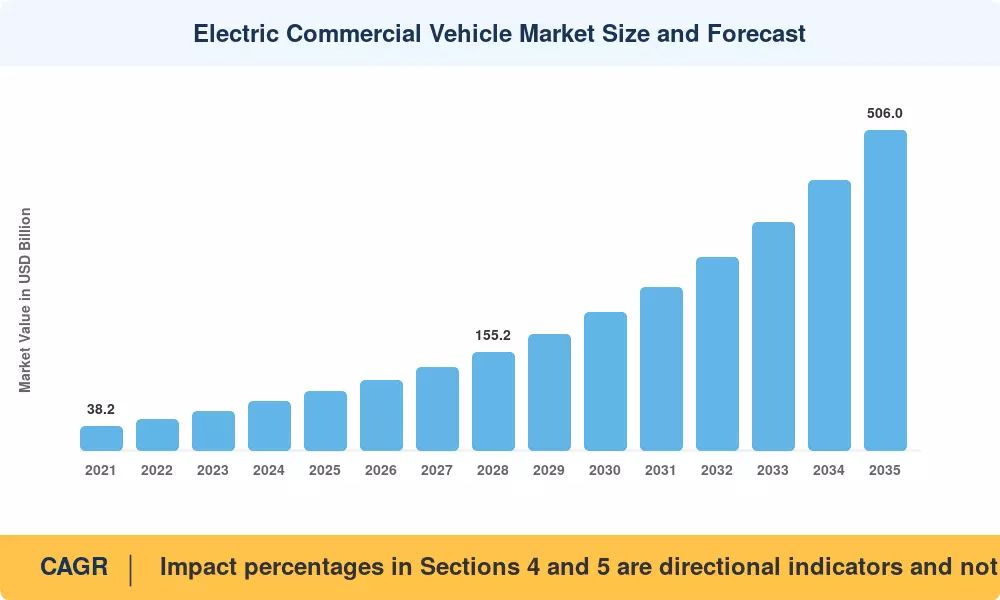
Electric Commercial Vehicle Market to Reach USD 506.0 Billion by 2035, Growing at 18.4% CAGR
Battery Electric Vehicles (BEV) held the dominant share of approximately 72% in 2025, supported by declining cell costs
Press Release Disclaimer: This is a press release distributed through the XPR Media network. It has not been independently verified by our newsroom.

Battery Electric Vehicles (BEV) held the dominant share of approximately 72% in 2025, supported by declining cell costs and expanding urban delivery use cases
NEW YORK, NY, UNITED STATES, August 27, 2026 /EINPresswire.com/ — According to Market Research Future, the Electric Commercial Vehicle Market is projected to grow from USD 110.7 billion in 2026 to USD 506.0 billion by 2035, registering a CAGR of 18.4% over the forecast period 2026 to 2035. This extraordinary growth trajectory reflects the accelerating global transition toward sustainable transportation solutions, where commercial fleets are increasingly electrifying to meet regulatory requirements, reduce operational costs, and align with corporate sustainability commitments.
Market Overview
Electric commercial vehicles encompass a broad range of electrically powered vehicles designed for freight transport, public transit, municipal services, and industrial applications. This segment includes battery electric vehicles, plug-in hybrid electric vehicles, and fuel cell electric vehicles across categories such as electric buses, light-duty trucks and vans, medium-duty trucks, and heavy-duty trucks. The market is undergoing a fundamental transformation as traditional internal combustion engine commercial vehicles are progressively replaced by zero-emission alternatives across global logistics and transportation networks.
The key growth drivers propelling this market expansion include stringent emission regulations and zero-emission mandates implemented by governments worldwide. Over 320 cities globally have implemented or formally announced low-emission or zero-emission zones, up from 228 in 2021, creating market-access requirements for logistics operators . Falling battery costs are another critical driver, with volume-weighted average lithium-ion pack prices dropping to USD 115/kWh, while BEV-specific pack prices fell to USD 97 per kWh, successfully crossing the USD 100 threshold . Government incentives and procurement programs for electric buses, trucks, and vans are accelerating adoption across public and private fleets. Additionally, ESG-linked procurement mandates from global shippers including Amazon, IKEA, and Maersk, representing combined freight expenditure exceeding USD 40 billion annually, are creating top-down demand signals for electric commercial vehicles .
The demand outlook for electric commercial vehicles remains exceptionally strong, driven by the convergence of regulatory pressure, technological advancement, and shifting consumer expectations. The Electric Bus Market has emerged as a significant growth segment, with cities like Shenzhen achieving 100% electric bus fleets and London, Paris, and Berlin mandating electric public buses by 2030 . Meanwhile, the Electric Delivery Van Market is experiencing explosive growth driven by the e-commerce boom and last-mile delivery electrification, with logistics giants deploying BEV vans for urban operations .
📍 Get Free Sample Report for Detailed Market Insights:
https://www.marketresearchfuture.com/sample_request/6921
Market Segmentation
The electric commercial vehicle market is segmented based on propulsion type, vehicle type, and application to provide comprehensive insights into the industry landscape.
By Propulsion Type: The market is categorized into Battery Electric Vehicles, Plug-in Hybrid Electric Vehicles, and Fuel Cell Electric Vehicles. Battery electric vehicles dominate the propulsion segment, attributed to their zero-emission profiles, high energy efficiency exceeding 90%, and compatibility with growing charging networks . BEVs offer cost-effective solutions for commercial use, especially for fixed routes and centralised operations, with falling battery costs averaging under USD 100/kWh by 2025 accelerating adoption . Plug-in hybrid electric vehicles continue to gain traction in regions with limited charging infrastructure, providing operators flexibility with dual-fuel capabilities for electric-only driving when needed and traditional engine assistance for longer trips . Fuel cell electric vehicles show promising potential in applications like long-haul trucking and regions with established hydrogen supply chains, offering extended range and faster refuelling times compared to battery electric alternatives .
By Vehicle Type: The market is divided into Electric Buses, Light-Duty Trucks & Vans, Medium-Duty Trucks, and Heavy-Duty Trucks. Electric buses and coaches dominate the market by volume, driven by public sector procurement and urban environmental regulations, with government-funded programs in China, India, and the European Union catalysing adoption through subsidies and fleet mandates . Light-duty trucks and vans represent the fastest-growing vehicle segment, driven by the e-commerce boom, urban low-emission zones, and increasing adoption of electric vans for last-mile and intra-city logistics operations . Companies such as Tata Motors, Ashok Leyland, and BYD are expanding deployment of electric light commercial vehicles for urban freight and delivery operations . Heavy-duty trucks, although facing higher adoption barriers due to range and charging infrastructure constraints, are gaining momentum in regional freight and logistics applications, with manufacturers like AB Volvo and Daimler Truck expanding portfolios through the Volvo FH Electric, Volvo FM Electric, and Mercedes-Benz eActros platforms .
By Application: The market is segmented into Logistics & Freight, Public Transit, Municipal Services, and Construction & Mining. Logistics and freight transportation represents the largest and fastest-growing application segment, driven by the surge in e-commerce and sustainable delivery initiatives . Last-mile delivery is emerging as the most dynamic application area, with logistics giants increasingly deploying BEV vans for urban operations . Public transportation applications are witnessing steady expansion, driven by urbanization and the need for eco-friendly transit solutions, with cities worldwide scaling electric fleets to meet decarbonisation commitments . Municipal services applications, including refuse collection and utility services, are adopting electric vehicles to reduce urban emissions and noise pollution. Construction and mining applications represent an emerging segment, with businesses looking to reduce carbon footprints through electric equipment deployment.
By Region: The market analysis covers North America, Europe, South America, Asia Pacific, and the Middle East and Africa, providing comprehensive geographic insights into regional dynamics and growth opportunities.
🛒 You can buy this market report at:
https://www.marketresearchfuture.com/checkout?currency=one_user-USD&report_id=6921
Regional Analysis
Asia Pacific emerges as the dominant and fastest-growing regional market for electric commercial vehicles, accounting for the majority of global market share. China leads the region with the world’s largest electric commercial vehicle market, driven by government initiatives promoting new energy vehicles, massive investments in electric logistics, and aggressive electrification of public transportation . Chinese manufacturers including BYD, Yutong Bus, Dongfeng Motor Corporation, and Foton Motor Group are expanding deployment of connected electric buses and trucks across domestic and international markets . India is gaining traction through expanding electric bus procurement under the FAME scheme, electric three-wheeler deployment, and increasing adoption of electric delivery vans for urban logistics . Japan, South Korea, and Australia represent advanced markets with sophisticated electric vehicle ecosystems, hybrid systems expertise, and growing demand for electric commercial vehicles across public transit and logistics applications . The Asia Pacific electric commercial vehicle market is expanding rapidly due to government initiatives, environmental regulations, and rising demand for sustainable transportation solutions .
Europe represents a mature and rapidly growing market, shaped by ambitious carbon neutrality goals, ultra-low-emission zones, and strong OEM leadership . Cities including London, Paris, and Berlin are enforcing diesel bans and mandating electric public buses by 2030 . National governments across the European Union are offering procurement subsidies and tax relief for electric trucks and municipal vehicles, while OEMs like Daimler, Renault, and Volvo are scaling up production of zero-emission heavy vehicles . Cross-border freight initiatives like the EU’s Alternative Fuels Infrastructure Regulation are enabling interoperable charging infrastructure deployment, while smart logistics hubs, city mobility platforms, and green public procurement are reinforcing Europe’s dominance in commercial EV uptake . The European electric commercial vehicle market is growing steadily due to strong decarbonisation targets, zero-emission transport regulations, and expanding charging infrastructure across logistics and public transportation sectors .
North America represents a significant growth market, driven by strong government incentives, advancements in EV infrastructure, and corporate sustainability commitments . The United States leads the region with substantial investments in electrification of freight and delivery fleets, supported by federal and state-level incentive programs. Canada’s Zero Emission Vehicle Infrastructure Program is catalysing regional uptake through investments in DC fast-charging corridors, digital fleet management, and utility partnerships, accelerating ECV deployment across freight, last-mile delivery, and public transit . Tesla, Rivian, and traditional OEMs including Ford and Daimler Truck are expanding electric commercial vehicle portfolios for North American markets .
South America represents an emerging market with growing potential. Brazil, Mexico, and Chile are spearheading early adoption, driven by public health concerns and dense urban pollution pushing cities to pilot electric bus fleets in Santiago, São Paulo, and Mexico City . Governments are engaging with development banks and multilateral climate funds to finance low-emission transit projects, with Mexico deploying battery electric buses under blended finance models . Despite infrastructure limitations, OEM partnerships and public-private partnership models are enabling steady growth, with the region expected to shift further toward electric urban logistics and mass transit as charging infrastructure expands .
The Middle East and Africa represent a gradually developing market exploring ECV solutions, with growing momentum in the UAE, Saudi Arabia, and South Africa . Governments are piloting electric buses for urban transit and planning EV fleet adoption for logistics and municipal operations, with Dubai’s Roads and Transport Authority aiming to convert half its bus fleet to electric by 2030 . While domestic manufacturing is limited, vehicle imports and partnerships with global OEMs are bridging gaps, with public-private investments in charging infrastructure laying the groundwork for future growth .
Competitive Landscape and Key Players
The electric commercial vehicle market is highly competitive, featuring a mix of established automotive manufacturers, emerging EV specialists, and regional players competing for market share. The competitive landscape is characterized by technological innovation, strategic partnerships, fleet expansion, and geographic diversification.
Key players operating in this market include Tesla, BYD, AB Volvo, Daimler Truck Holding AG, Rivian Automotive, Ford Motor Company, Proterra, Yutong Bus Co., Tata Motors, Ashok Leyland, Dongfeng Motor Corporation, and International Motors . These industry leaders are investing heavily in research and development to create advanced electric commercial vehicle platforms that support various applications and operating conditions.
Strategic developments are reshaping the competitive landscape. Major players are forming partnerships with battery manufacturers, charging infrastructure providers, and technology companies to secure supply chains and enhance product offerings. OEMs are expanding their electric commercial vehicle portfolios through new product launches, with manufacturers like Volvo Trucks, Ford, BYD, and Proterra rapidly expanding their BEV commercial portfolios, accelerating fleet-level electrification in freight, transit, and service industries . Chinese manufacturers including BYD, Yutong Bus, and FAW Group are expanding international presence through exports and partnerships with global OEMs .
Latest Industry News and Developments
Recent industry developments highlight the dynamic nature of the electric commercial vehicle market. Major automotive manufacturers continue to expand their electric commercial vehicle portfolios through new product launches and strategic investments. AB Volvo is expanding deployment of the Volvo FH Electric and Volvo FM Electric for regional freight operations, while Daimler Truck is strengthening its portfolio through the Mercedes-Benz eActros platform .
In the bus segment, BYD and Yutong are increasing deployment of connected electric buses with fast-charging compatibility and intelligent fleet-monitoring systems across European cities . Chinese players including XCMG Global, SANY Group, FAW Group, and CNHTC continue to dominate the market, with significant production and deployment capabilities across domestic and international markets .
Logistics and e-commerce giants are accelerating fleet electrification through strategic partnerships with EV manufacturers. Amazon, through its partnership with Rivian, and DHL, which reported 48% electrification in its German fleet, are demonstrating the viability of electric commercial vehicles for last-mile delivery operations . These developments underscore the accelerating transition toward sustainable commercial transportation across global markets.
Market Challenges and Opportunities
The electric commercial vehicle market faces several key challenges that could impact growth trajectories. High upfront vehicle acquisition cost remains a significant barrier, with electric Class 8 tractors carrying sticker prices roughly 2.0 to 2.5 times that of comparable diesel units, ranging from USD 350,000 to USD 450,000 depending on battery capacity . Small and medium fleet operators, accounting for over 90% of trucking companies in the United States, often lack access to low-cost capital or leasing structures needed to bridge this gap .
Charging infrastructure availability represents another critical challenge. The U.S. Department of Energy estimates that meeting projected electric truck fleets will require over 40,000 public and depot-based fast chargers by 2030, against fewer than 4,500 installed as of mid-2025 . The challenge intensifies for long-haul operations, with megawatt-class chargers capable of adding 300 miles of range in 30 minutes remaining in pilot stages, with only 120 units operational across North America and Europe combined . Rural and intercity corridors present the starkest gaps, creating range-anxiety barriers that slow adoption for regional and long-distance routes .
Battery material supply constraints pose additional challenges. Lithium, cobalt, and nickel supply chains remain concentrated, with approximately 65% of global lithium refining and 77% of cobalt processing occurring in China . Geopolitical tensions, export controls, and mining permit timelines introduce price volatility that complicates OEM cost planning and manufacturing strategies .
Emerging opportunities are abundant in the evolving mobility landscape. The shift toward software-defined commercial vehicles presents enormous potential for electric commercial vehicle providers, as vehicles increasingly become platforms for continuous software innovation and feature upgrades. The growing demand for electric delivery vans and last-mile logistics solutions creates new opportunities for specialized vehicle platforms optimized for urban operations . The expansion of battery swapping solutions, smart charging infrastructure, and vehicle-to-grid technologies offers significant growth potential for innovative business models and service offerings.
To explore more market insights, visit us at:
https://www.marketresearchfuture.com/reports/electric-commercial-vehicle-market-6921
Final Market Summary
The transition from internal combustion engine commercial vehicles to electric alternatives represents a fundamental industry evolution, positioning electric commercial vehicles as essential components of the sustainable transportation ecosystem. As battery technology advances, charging infrastructure expands, and total cost of ownership continues to favor electric options, the adoption of electric commercial vehicles will accelerate across all vehicle categories and geographic regions, ensuring continued growth and innovation throughout the forecast period and beyond.
More Related Reports from MRFR Library:
Bus HVAC Market : https://www.marketresearchfuture.com/reports/bus-hvac-market-29969
Automotive Power Window Motor Market : https://www.marketresearchfuture.com/reports/automotive-power-window-motor-market-30127
Abrasive Wheels Market : https://www.marketresearchfuture.com/reports/abrasive-wheels-market-30205
Automotive Harness System Market : https://www.marketresearchfuture.com/reports/automotive-harness-system-market-30334
Smart Ev Charger Market : https://www.marketresearchfuture.com/reports/smart-ev-charger-market-30609
VVT Actuators Market : https://www.marketresearchfuture.com/reports/vvt-actuators-market-30658
Millimeter Wave Radar Market : https://www.marketresearchfuture.com/reports/millimeter-wave-radar-market-30826
Electric DC Motor Market : https://www.marketresearchfuture.com/reports/electric-dc-motor-market-30830
Automotive LCD Display Market : https://www.marketresearchfuture.com/reports/automotive-lcd-display-market-30951
Smart Vehicle Cabin Market : https://www.marketresearchfuture.com/reports/smart-vehicle-cabin-market-30964
Market Research Future
Market Research Future
+1 855-661-4441
email us here
Legal Disclaimer:
EIN Presswire provides this news content “as is” without warranty of any kind. We do not accept any responsibility or liability
for the accuracy, content, images, videos, licenses, completeness, legality, or reliability of the information contained in this
article. If you have any complaints or copyright issues related to this article, kindly contact the author above.

Media gallery