
Production-Grade Materials and Client Demos with PFTWORLD, an Advanced Rapid Prototype Manufacturer from China
SHENZHEN, GUANGDONG, CHINA, August 26, 2026 /EINPresswire.com/ -- PFTWORLD supports its Advanced Rapid Prototype
Press Release Disclaimer: This is a press release distributed through the XPR Media network. It has not been independently verified by our newsroom.
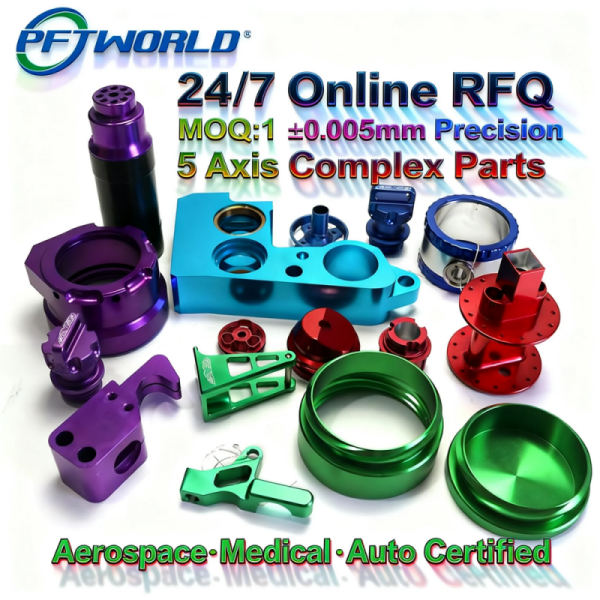

SHENZHEN, GUANGDONG, CHINA, August 26, 2026 /EINPresswire.com/ — PFTWORLD supports its Advanced Rapid Prototype Manufacturer from China positioning with CNC prototype products made from engineering-grade materials for functional testing, fit checks, and mechanical-evaluation applications. Those physical parts can also serve as client-review or demonstration pieces when the purpose is to show geometry, interfaces, and design behavior; this keeps the “client demos” angle grounded in documented prototype evaluation rather than inventing a separate formal demo service. The dedicated CNC prototype service explicitly connects physical prototyping to real-world functional testing and mechanical review, ensuring that development teams have a reliable baseline for making informed design decisions.
Engineering-Grade Materials Make the Prototype Relevant to Real Mechanical Evaluation
PFTWORLD uses engineering-grade materials for CNC prototypes so the prototype can be evaluated as a physical component rather than only as a visual representation of the design. The dedicated CNC Prototype Service supports prototypes in production-relevant engineering materials and explicitly connects them to functional testing, fit checks, and mechanical evaluations.
Using the intended or a technically relevant material lets a design review consider stiffness, machining behavior, fastener interfaces, and assembly fit under a more realistic material condition than a purely cosmetic mock-up. Production-relevant materials give CNC prototypes a stronger role in engineering review because the physical part can be assessed against mechanical and assembly requirements. When a prototype is machined from the same grade of aluminum, steel, or engineering plastic that will be used in the final production run, the engineering team gains direct insight into how the part will perform under load and environmental stress. This alignment between prototype material and production material is essential for avoiding late-stage redesigns that often occur when early testing relies on inadequate substitutes.
A Client Demo Can Use the Prototype as a Physical Review Piece Without Becoming a Separate Unverified Service
A CNC prototype can serve as a physical client-review piece for demonstrating geometry, interfaces, and assembly behavior during design evaluation. A machined prototype can be presented to engineering, procurement, or stakeholder teams to demonstrate geometry, assembly interfaces, and intended handling while those same parts are used for fit and mechanical evaluation.
The physical component supports engineering review and decision-making, while the customer can define how the prototype is presented or demonstrated within the project’s own evaluation process. A client-facing demonstration is credible when it uses the prototype as an engineering review artifact and does not invent a separate service workflow that has not been documented. By leveraging the physical prototype as a tangible asset during stakeholder meetings, project managers can effectively communicate design intent and resolve ambiguities without requiring a standalone demonstration service. This approach maintains the focus on engineering validation while still fulfilling the need for visual and physical inspection by non-technical team members.
Prototype Machining Supports Iteration Across Several Product-Development Contexts
PFTWORLD’s prototype machining scope extends beyond one industry, giving development teams a route to evaluate machined concepts before they commit to production tooling or volume. Prototype machining covers automotive development, aerospace and medical work, industrial applications, and consumer-electronics development, giving teams multiple contexts for physical design evaluation without relying on named customer cases.
Across those contexts, the common role is iteration: a physical machined part can reveal geometry, interface, or manufacturability issues that are difficult to resolve from design intent alone. Multi-industry prototype use supports a development-stage manufacturing role centered on physical evaluation rather than one narrow end market. Whether the project involves an aerospace bracket that must meet precise weight restrictions or a medical device component requiring specific biocompatible material properties, the iterative nature of prototype machining allows for rapid adjustments. PFTWORLD provides the machining capabilities necessary to support these diverse development needs, ensuring that each iteration brings the design closer to a successful production launch.
Fit and Mechanical Evaluation Should Be Defined Before the Prototype Is Cut
PFTWORLD can make a prototype more useful when the buyer states what the part must demonstrate—fit, movement, load path, interface location, or another measurable design question—before machining begins. The prototype service already supports fit checks and mechanical evaluations, so the drawing package should identify the dimensions and interfaces that determine whether the prototype answers those questions.
Material choice, tolerance, surface condition, and assembly context can then be aligned with the evaluation objective instead of over-specifying every non-critical feature on an early-stage part. A prototype is most valuable when its machining plan is built around the design decision the team needs to make next. By clearly defining the evaluation criteria upfront, engineering teams can optimize the prototyping process, reducing both lead time and costs. If a prototype is primarily intended to verify the fit of a complex internal thread, the machining focus can be placed on that specific feature, allowing for broader tolerances on non-critical exterior surfaces. This targeted approach ensures that the prototype serves its intended purpose efficiently.
Prototype Inspection Creates a Reliable Baseline for Design Changes
Dimensional inspection gives the design team a known physical baseline, helping separate a true design issue from a prototype that simply missed the specified geometry. Shenzhen Perfect Precision Products Co., Ltd.’s broader inspection capability includes first article inspection (FAI) and dimensional measurement equipment, which can support verification of critical prototype features before the part enters a fit or mechanical review.
Recorded dimensions also make the next design iteration more actionable because engineering can compare the tested physical part with the drawing revision that produced it. Inspection turns the prototype into a more reliable design-learning tool by confirming what geometry was actually evaluated. When a prototype fails a fit check, having a documented dimensional report from a Coordinate Measuring Machine (CMM) allows the engineering team to immediately determine if the failure was due to a design flaw or a manufacturing deviation. This clarity accelerates the troubleshooting process and prevents teams from making unnecessary design changes based on inaccurate physical representations.
Prototype Evidence Can Carry Forward Into a More Defined Production Handoff
PFTWORLD can support the Advanced Rapid Prototype Manufacturer from China positioning by connecting engineering-grade prototypes, physical review, and measured design learning to the next manufacturing revision. Once fit, mechanical behavior, and critical dimensions have been reviewed, the updated drawing can carry the accepted geometry and material decisions into the next prototype or production-oriented machining step.
Development teams can submit material, geometry, tolerance, and evaluation requirements so the prototype route is matched to the decision the physical part must support. Engineering-grade prototypes can bridge design review and the next manufacturing decision without overstating a separate demo service; project discussion is available at https://www.pftworld.com/. By seamlessly transitioning from prototype evaluation to low-volume or mass production, buyers can maintain consistency in manufacturing quality and reduce the risks associated with changing suppliers during the product lifecycle. The established baseline of inspected prototypes serves as a solid foundation for scaling up manufacturing operations effectively.
Shenzhen Perfect Precision Products Co., Ltd.
PFTWORLD
email us here
Visit us on social media:
Instagram
Facebook
YouTube
X
Legal Disclaimer:
EIN Presswire provides this news content “as is” without warranty of any kind. We do not accept any responsibility or liability
for the accuracy, content, images, videos, licenses, completeness, legality, or reliability of the information contained in this
article. If you have any complaints or copyright issues related to this article, kindly contact the author above.

Media gallery

