How to Choose the Right Energy Storage Battery in 2026: From Residential Systems to Utility-Scale BESS
GSL ENERGY outlines key battery storage solutions and selection criteria for residential, C&I, and utility-scale energy
Press Release Disclaimer: This is a press release distributed through the XPR Media network. It has not been independently verified by our newsroom.

GSL ENERGY outlines key battery storage solutions and selection criteria for residential, C&I, and utility-scale energy storage projects in 2026.
深圳, 广东省 — GUANGDONG SHENG, CHINA, August 20, 2026 /EINPresswire.com/ — Shenzhen, China — August 2026 — As solar power adoption and distributed energy systems continue to expand, battery energy storage is becoming an increasingly important part of modern power infrastructure. From residential solar batteries to commercial and industrial BESS and MWh-scale containerized systems, energy storage technologies are now available for a wide range of applications.
However, choosing an energy storage battery is no longer simply a matter of comparing battery capacity or price per kWh. System voltage, usable capacity, cycle life, thermal management, safety protection, inverter or PCS compatibility, scalability, certification, and installation conditions can all affect the suitability of a battery storage solution.
GSL ENERGY, a LiFePO4 battery manufacturer and battery energy storage system provider, has outlined several energy storage architectures for different application scenarios in 2026, covering residential, commercial and industrial, and utility-scale projects.
Energy Storage Is Expanding Across Three Major Application Segments
Energy storage systems can broadly be divided into three categories according to their application.
Residential energy storage generally ranges from several kilowatt-hours to several tens of kilowatt-hours. These systems are primarily used for home solar energy storage, self-consumption, backup power, and off-grid applications.
Commercial and industrial energy storage typically ranges from tens of kWh to hundreds of kWh or even MWh-scale installations. Common applications include factories, warehouses, commercial buildings, agricultural facilities, EV charging sites, and microgrids.
At the larger end of the market, utility-scale and containerized BESS are mainly measured in MWh and are designed for solar and wind projects, grid-side energy storage, large microgrids, and other large-scale energy applications.
This wide range of applications means that there is no single battery configuration that is suitable for every project.
Residential Energy Storage: Flexible Battery Architectures for Homes
For homeowners and residential solar installers, installation flexibility, usable capacity, backup duration, inverter compatibility, and future expansion are among the key considerations.
Wall-Mounted LiFePO4 Batteries
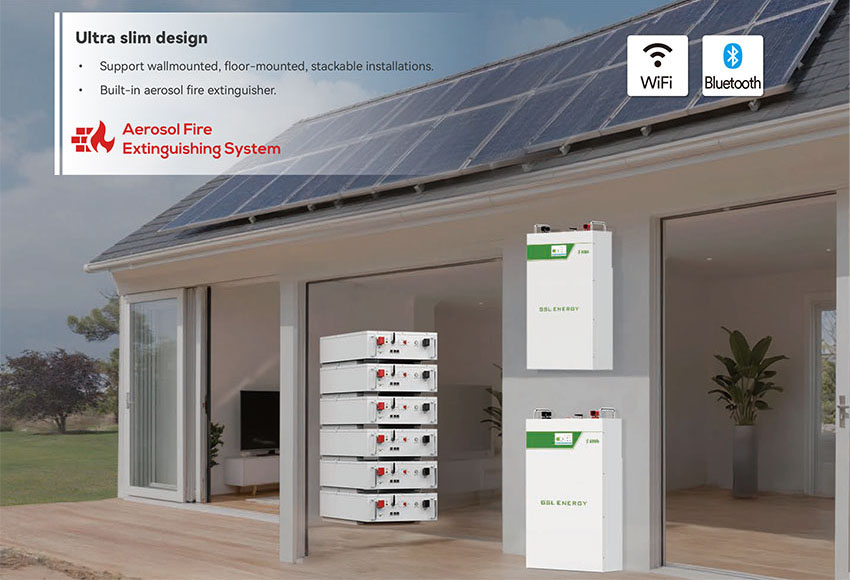
Wall-mounted batteries remain a practical choice for residential solar storage because they provide a compact installation footprint while allowing batteries to be integrated with residential solar systems.
GSL ENERGY’s GSL051100A-B-GBP2 uses a modular architecture and supports wall-mounted, stacked, wall-side, and bracket installation. The system is available with 5kWh and 10kWh battery modules and can support parallel expansion through the company’s battery management architecture.
The system also features intelligent battery monitoring, LCD operation, APP and web-based monitoring, compatibility with more than 30 mainstream inverter brands, and an integrated aerosol fire suppression device.
For households with moderate electricity consumption, this type of modular battery architecture can provide a practical starting point while leaving room for future storage expansion.
Floor-Mounted Energy Storage Batteries
For larger homes and small commercial projects, floor-mounted batteries can provide additional installation flexibility and higher storage capacity.
The GSL051280A-B-GBP2F supports 51.2V 280Ah/14.34kWh and 51.2V 314Ah/16.08kWh configurations. Up to 16 units can be connected in parallel, allowing approximately 257kWh of total capacity under the specified configuration.
The system uses LiFePO4 battery cells and provides IP65 protection, up to 95% DoD, 1C continuous discharge, and a specified cycle life of more than 8,500 cycles. Product certifications include UL1973, UL9540A, UL9540, CB-IEC62619, and CE-EMC as specified for the product.
This architecture can be considered for high-consumption homes, residential backup applications, and small commercial projects requiring larger battery capacity.
Rolling Energy Storage Batteries
Mobility can also be an important consideration in certain energy storage applications.
The LL-NE series combines floor-mounted battery storage with an integrated wheel structure, allowing equipment to be repositioned more easily during installation or deployment. Available configurations include 16kWh, 20kWh, and 32kWh options.
The system includes APP and web monitoring, an LCD interface, intelligent BMS, IP65 protection, integrated aerosol fire suppression, and automatic pressure relief.
For residential and light-commercial projects where deployment flexibility and mobility are important, this type of architecture provides an alternative to fixed wall-mounted storage.
High-Voltage Battery Systems for Larger Residential and Small C&I Projects
As storage capacity increases, high-voltage battery architecture becomes increasingly relevant to residential and commercial applications.
GSL ENERGY’s HV-G2 Pro to HV-G12 Pro series uses a modular stackable high-voltage architecture based on LiFePO4 battery technology. The series provides more than 6,000 cycles under specified conditions, integrated BMS, up to 90% DoD, and an operating temperature range of approximately -20°C to 60°C.
A high-voltage architecture can help reduce current requirements at the same power level and can be matched with high-voltage hybrid inverters or other high-voltage energy storage systems.
For installers working on larger residential systems or small C&I projects, modular high-voltage storage can provide a scalable approach without immediately moving to a large centralized BESS.
Rack-Mounted Batteries for Commercial and Industrial Applications
For B2B energy storage projects, standardized installation and modular expansion are often more important than the compact form factor required in residential applications.
Rack-mounted battery systems can simplify installation and maintenance while providing a standardized platform for EPC contractors, installers, distributors, and system integrators.
GSL ENERGY’s GSL-R20K to GSL-R60K series uses a 19-inch rack-mounted structure, LiFePO4 battery cells, intelligent BMS, multiple protection functions, and parallel expansion capabilities. The series is specified at more than 6,500 cycles under the stated test conditions and supports 1C continuous charge and discharge.
The company’s GSL-128K to GSL-241K series also adopts a standardized rack architecture and modular configuration for larger energy storage applications.
These systems can be considered for commercial backup power, industrial energy storage, microgrids, telecommunications, and BESS integration.
All-in-One BESS for Small and Medium-Sized C&I Projects
For factories, warehouses, commercial buildings, and agricultural facilities, an all-in-one BESS can integrate multiple system components into a unified platform.
GSL ENERGY’s BESS-30K40 to BESS-30K60 series is designed for small C&I applications and combines a standardized battery architecture with air cooling, intelligent BMS, and multiple battery protection functions.
The specified configuration can provide up to 60kWh of capacity, with larger configurations within the product family expandable to approximately 241kWh depending on the system architecture. The system supports parallel configuration and includes certifications specified for the relevant product models, including UL1973, UL9540A, UL9540, CB-IEC62619, and CE-EMC.
Potential applications include factory peak shaving, time-of-use energy management, solar-plus-storage systems, commercial backup power, warehouse storage, agricultural energy storage, and small microgrids.
Air Cooling or Liquid Cooling? Thermal Management Matters
Thermal management becomes increasingly important as battery capacity and energy density increase.
For smaller and medium-sized systems, air cooling can provide a practical balance between system cost, deployment efficiency, maintenance requirements, and operating performance.
GSL ENERGY’s air-cooled All-in-One C&I BESS integrates the battery system, BMS, PCS, EMS, thermal management, and safety functions into a unified platform. The system can be expanded to approximately 241kWh depending on configuration and supports parallel operation.
For higher-energy-density applications, liquid cooling can provide a more controlled approach to battery thermal management.
The company’s C&I CESS-UL for the U.S. market integrates the battery system, BMS, PCS, EMS, fire protection, and thermal management. It supports grid-connected and off-grid operation, peak shaving, renewable energy integration, three-phase backup power, and flexible system expansion.
Another liquid-cooled C&I platform is designed for large factories, industrial parks, commercial campuses, microgrids, and other high-capacity applications. Its architecture integrates cooling, power control, fire protection, monitoring, intelligent balancing, and real-time alarms.
The choice between air cooling and liquid cooling should therefore be based on battery capacity, energy density, operating conditions, thermal requirements, and the overall project design rather than on cooling technology alone.
Containerized BESS for MWh-Scale Energy Storage
At the utility and large-project level, containerized battery energy storage systems provide a standardized architecture for large-scale deployment.
A 5MWh-class containerized BESS can integrate battery modules, PCS, BMS, thermal management, and fire protection within a containerized platform.
Key design considerations include modular expansion, multi-level safety protection, temperature monitoring, automatic emergency response, combustible gas ventilation, explosion-proof exhaust design, and independent thermal management and fire protection.
Such systems are intended for applications including large-scale solar farms, wind power projects, grid-side energy storage, large microgrids, and utility-scale renewable energy projects.
What Should Buyers Check Before Purchasing an Energy Storage Battery?
Battery capacity is only one part of the purchasing decision.
For residential and B2B projects, buyers should evaluate the complete system rather than focusing solely on the initial battery price.
Capacity and Usable Energy
Rated battery capacity does not necessarily represent the amount of energy available for daily use.
Battery sizing should take into account daily electricity consumption, load power, solar PV generation, required backup duration, DoD, reserve capacity, system efficiency, and the intended operating strategy.
Voltage Architecture
Low-voltage and high-voltage batteries serve different system architectures. The battery DC voltage must be compatible with the selected hybrid inverter or PCS.
For larger storage systems, the voltage architecture should be considered together with power requirements, current levels, cable design, inverter compatibility, and system expansion requirements.
Battery Chemistry
LiFePO4, or lithium iron phosphate, is widely used in the energy storage products described by GSL ENERGY.
However, chemistry alone does not determine the performance of an energy storage system. Cell quality, BMS design, thermal management, system integration, operating conditions, and safety architecture also need to be evaluated.
Cycle Life and Operating Conditions
Cycle-life figures should always be considered together with the test conditions.
DoD, charge and discharge rate, ambient temperature, and end-of-life criteria can all influence how cycle-life specifications should be interpreted.
BMS and Communication Compatibility
The Battery Management System monitors battery voltage, current, temperature, SOC, and other operating parameters while implementing protection strategies.
For installers and system integrators, communication compatibility between the battery, inverter, PCS, and EMS is also important because it can affect commissioning and system operation.
Thermal Management and Environmental Protection
The appropriate thermal management solution depends on system capacity and energy density.
Air cooling may be suitable for many smaller and medium-sized systems, while larger and higher-energy-density systems may require liquid cooling.
Installation conditions also need to be considered. Depending on the model, energy storage products may provide IP55 or IP65 protection, but the exact protection rating should always be confirmed against the applicable product datasheet.
Certifications and Local Compliance
Energy storage systems must meet the applicable technical and regulatory requirements of their target market.
Common standards and certifications associated with energy storage products include UL1973, UL9540, UL9540A, IEC62619, CB, CE, UN38.3, and MSDS.
Because certification coverage can vary between products and configurations, buyers should verify the certification documents for the exact battery model and system configuration before procurement.
Choosing the Right Energy Storage Architecture in 2026
The appropriate energy storage solution depends primarily on the project’s application and operating requirements.
For a typical residential solar-plus-storage system, 5kWh-class or 10kWh-class wall-mounted batteries can provide a compact starting point. Larger homes may require 14–16kWh-class floor-mounted systems or multiple battery units connected in parallel.
For high-consumption homes and high-voltage applications, modular high-voltage batteries can provide an alternative architecture.
For small factories, warehouses, commercial buildings, and agricultural facilities, 40–60kWh-class All-in-One BESS products can be considered, with larger configurations available for projects requiring additional capacity.
Large factories, industrial parks, and commercial campuses may require liquid-cooled C&I BESS based on their load profile, required power, energy capacity, operating strategy, and thermal management requirements.
For MWh-scale solar, wind, grid-side, and microgrid projects, liquid-cooled BESS and containerized energy storage systems provide scalable architectures for large-scale deployment.
There Is No Single “Best” Energy Storage Battery
The rapid development of the energy storage market is shifting the focus from individual batteries toward complete Battery Energy Storage System solutions.
A modern BESS may combine battery cells with BMS, PCS, EMS, thermal management, fire protection, monitoring, and energy management functions. As a result, system integration and project compatibility can be just as important as the battery itself.
For residential projects, buyers may prioritize usable capacity, installation flexibility, inverter compatibility, safety, monitoring, and future expansion.
For commercial and industrial applications, power output, peak shaving, time-of-use energy management, system efficiency, scalability, thermal management, and project economics become increasingly important.
For utility-scale projects, system integration, thermal management, fire protection, grid connection, long-term operating performance, safety design, and project-specific compliance requirements must all be considered.
Ultimately, the best energy storage battery is not necessarily the battery with the largest capacity or the lowest upfront price. The more appropriate solution is the one that provides a practical balance of safety, efficiency, cycle life, compatibility, scalability, certification, deployment requirements, and total cost of ownership.
As energy storage projects continue to diversify in 2026, defining the application, load profile, daily energy consumption, solar PV capacity, required storage capacity, backup duration, and grid requirements should remain the starting point for battery selection.
Xiang Ye
Shenzhen GSL Energy Co.,Ltd
+86 13923720280
email us here
Visit us on social media:
LinkedIn
Instagram
Facebook
Legal Disclaimer:
EIN Presswire provides this news content “as is” without warranty of any kind. We do not accept any responsibility or liability
for the accuracy, content, images, videos, licenses, completeness, legality, or reliability of the information contained in this
article. If you have any complaints or copyright issues related to this article, kindly contact the author above.

Media gallery