Medicinal Genomics’ One-Reaction Listeria Test Earns AOAC Certification for Whey Powder, Foods, and Surfaces
PathoSEEK® qPCR detects Listeria species and L. monocytogenes together, giving supplement and food makers one platform
Press Release Disclaimer: This is a press release distributed through the XPR Media network. It has not been independently verified by our newsroom.


Medicinal Genomics Corporation (MGC) today announced that its PathoSEEK® Listeria mono & spp. Multiplex Detection Assay with MaGiC™ Lysis has earned AOAC Research Institute’s Performance Tested Methods℠ certification (No. 112601) for whey powder, ready-to-eat meats, fresh spinach, and environmental surfaces. The qPCR test detects Listeria species and Listeria monocytogenes in a single reaction, delivers next-day results for most sample types, and is designed for automation on Bio Molecular Systems’ Myra liquid handler.
This press release features multimedia. View the full release here: https://www.businesswire.com/news/home/20261119725123/en/
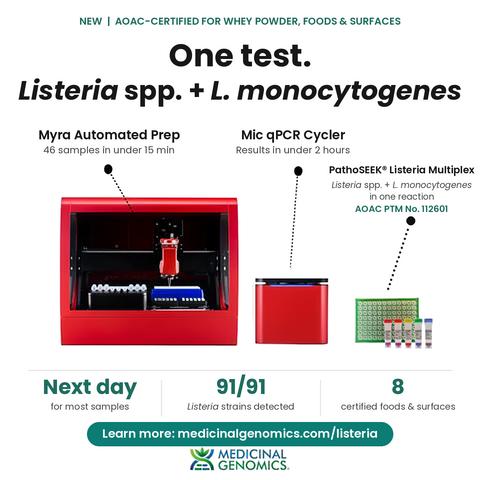
Medicinal Genomics’ AOAC-certified Listeria testing workflow: the Bio Molecular Systems Myra liquid handler for automated sample prep, the Mic qPCR cycler, and the PathoSEEK® Listeria mono & spp. Multiplex Detection Assay (AOAC PTM No. 112601). The assay detects Listeria species and Listeria monocytogenes in a single reaction and is certified for whey powder, ready-to-eat meats, fresh spinach, and environmental surfaces.
Highlights from the PTM Certification Study at Q Laboratories
- Certified for ready-to-eat deli turkey, hot dogs, fresh bagged spinach, whey powder, and stainless steel, ceramic, plastic, and sealed concrete surfaces
- Detected all 91 target Listeria strains, including 51 L. monocytogenes strains, and excluded all 46 non-target organisms
- No statistically significant difference from USDA and FDA culture methods on any food, surface, or instrument
- Results the day after sampling, with a 24–28 hour enrichment for most samples
Listeria Contamination Risk
Listeria has the highest fatality rate of the major foodborne pathogens. The CDC estimates it sickens about 1,600 Americans a year and kills about 260, and nearly everyone diagnosed is hospitalized. In 2025, Listeria caused 21 of the 22 deaths in U.S. foodborne illness outbreaks, according to U.S. PIRG’s Food for Thought 2026 report. Recent outbreaks tied to nutritional shakes (14 deaths), deli meat (10), and prepared pasta meals (7) killed 31 people. In the pasta outbreak, almost a year passed between the first illness and the recall.
“Listeria caused nearly every U.S. foodborne outbreak death last year, and the outbreaks keep showing the same pattern: contamination found weeks or months too late,” said Brendan McKernan, CEO of Medicinal Genomics. “Nutritional shakes are part of that story. Certifying whey powder alongside meats, produce, and environmental surfaces adds Listeria to our microbial testing solution for supplements.”
Food manufacturers swab surfaces for Listeria species as an early warning and test product for L. monocytogenes itself. Many qPCR methods use a separate kit for each target. One reaction answers both questions with one sample and one run. An internal control in every reaction guards against false negatives. An optional certified step removes DNA from dead cells, which can skew qPCR results after sanitation.
Certified by Independent Reviewers
AOAC PTM certification is an independent review confirming that a test performs as its maker claims. Q Laboratories, an independent food microbiology laboratory, ran the inclusivity, exclusivity, and matrix studies. It compared the assay with USDA MLG 8.15 and FDA BAM Chapter 10. On stainless steel and ceramic, paired testing showed results equivalent to the reference method.
“Rapid methods offer significant advantages by reducing turnaround times, enabling quicker decision-making, and helping food manufacturers identify potential microbiological hazards before products reach consumers. However, speed alone is not enough,” said Ben Bastin, Director of Microbiology Operations at Q Laboratories. “These methods must be thoroughly validated to demonstrate that they are accurate, reliable, reproducible, and fit for their intended purpose. Robust validation provides confidence that rapid methods perform consistently across different food matrices, processing environments, and testing conditions. The PathoSEEK Listeria method has been validated for select foods and environmental surfaces and compared to the U.S. reference methods. By statistically comparing the rapid method and the reference method, no statistical differences were observed.”
Designed with Automation in Mind
The PathoSEEK workflow is easily automated using the Bio Molecular Systems (BMS) Myra liquid handler, which prepares 46 samples in under 15 minutes, limiting hands-on time and user error. Medicinal Genomics recommends the BMS Mic qPCR cycler, which produces results in under two hours; the assay is also certified on Bio-Rad CFX96 Touch and CFX Opus systems. The kit (catalog no. 420545) is available now. Food and supplement labs can find the full validation data package at medicinalgenomics.com/product-literature.
Mic and Myra are trademarks of Bio Molecular Systems Pty Ltd. Bio-Rad, CFX96 Touch, and CFX Opus are trademarks of Bio-Rad Laboratories, Inc. All other trademarks are the property of their respective owners.
About Medicinal Genomics
Medicinal Genomics is a molecular diagnostics company that develops PathoSEEK® qPCR assays and automated workflows for microbial testing in regulated industries. Having built its platform in cannabis and hemp testing, the company now serves dietary supplements, natural products, and food manufacturers. Its patent-pending LIDAR qPCR reporter chemistry combines quantification, deep multiplexing, and high-resolution melt in one reaction on existing thermocyclers. Learn more at medicinalgenomics.com.
Follow Medicinal Genomics on LinkedIn, X, Instagram, Facebook and YouTube.
View source version on businesswire.com: https://www.businesswire.com/news/home/20261119725123/en/
Media gallery